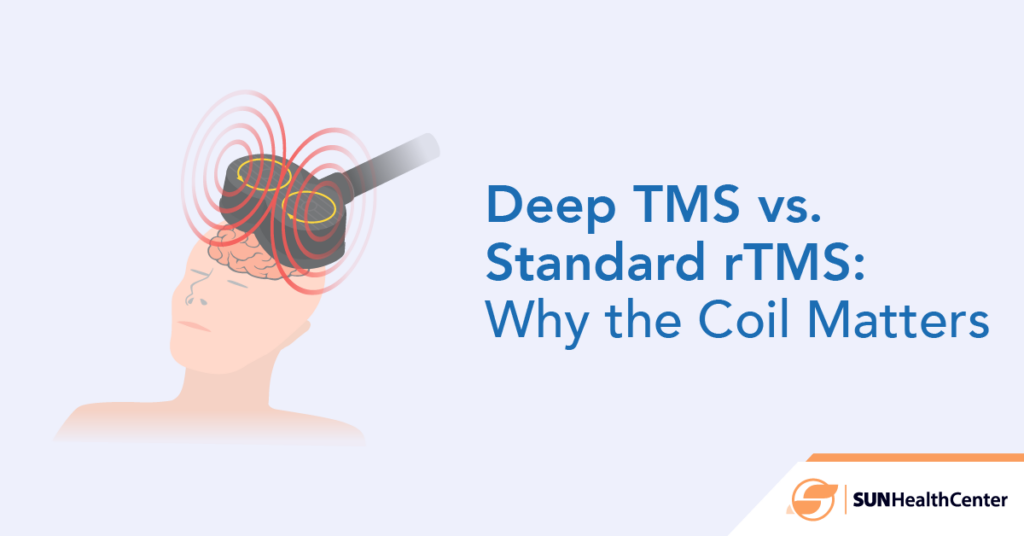
Deep TMS uses an H-coil helmet to stimulate deeper structures in the brain. Find out how Sun Health Center uses this type of transcranial magnetic stimulation.
Deep TMS and standard rTMS are similar, but the deep version uses an H-coil helmet instead of a figure-eight coil. Both therapies use magnetic impulses to stimulate nerve cells in the brain, but they don’t work exactly the same way. At Sun Health Center, we use the BrainsWay deep TMS system as a noninvasive treatment for depression.
What Is Transcranial Magnetic Stimulation (TMS)?
Transcranial magnetic stimulation, better known as TMS, uses magnetic fields to create electrical signals in certain areas of the brain. By targeting specific regions, clinicians can address issues related to overactivity or underactivity, making TMS useful for depression, obsessive-compulsive disorder (OCD) and depression paired with anxiety. The treatment is FDA-cleared for treatment-resistant depression, which is depression that fails to respond to at least two antidepressant medications.
Deep TMS vs. Standard rTMS: How the Technology Differs
Both standard rTMS and deep TMS use a technique known as electromagnetic conduction. This is the process of using a magnetic field to produce electrical impulses. During a TMS session, a treatment coil produces short magnetic impulses, creating electrical activity in one of the brain’s targeted areas.
The key difference between rTMS and deep TMS is how the coils are designed. A figure-eight coil allows clinicians to focus on a single area of the brain, making it ideal for patients whose symptoms arise from a single region.
Deep TMS uses an H-coil, which has several windings (insulated pieces of copper wire) arranged in the shape of a helmet. The helmet design produces a larger magnetic field, allowing clinicians to target deeper areas of the brain. At Sun Health Center, we use the BrainsWay system to deliver deep impulses.
Why Does TMS Coil Design Matter?
The regions of the brain associated with depression and OCD are part of complex networks. In people with mental health conditions, structures within these networks can’t communicate effectively. This is why TMS coil design matters. Changing the coil affects the size of the magnetic field, which influences the amount of stimulation delivered to the deeper structures within the brain.
Figure-eight coils are more effective for targeted stimulation, but since they only have two windings, proper placement is critical. Small differences in positioning can affect the strength of the impulses delivered to the target structure.
The H-coils used for deep TMS stimulate a wider area, making it easier to accommodate patients with anatomical differences. Placement isn’t as important with the H-coil as it is with the figure-eight coil, allowing clinicians to reach beyond the most superficial brain structures. When researchers from Italy reviewed previous studies on the effectiveness of deep TMS, they noted a response rate of 32.6% with this technique compared to just 14.6% for sham treatment.
How Deep TMS Reaches Deeper Parts of the Brain
Many people wonder how deep the magnetic impulses actually go, but there’s no universal answer. Magnetic field strength depends on several factors, such as individual anatomy, coil geometry and the intensity of the stimulation. It’s more important to understand why deep TMS is so effective for treatment-resistant depression and obsessive-compulsive disorder.
H-coils prevent excess stimulation while creating electrical impulses across broader regions of the brain. Since mental health conditions often arise from multiple structures, deep TMS allows us to help patients who’ve tried other treatments without success. For example, major depressive disorder (MDD) may occur when the thalamus, hippocampus and amygdala can’t communicate properly.
Is Deep TMS Better Than Regular TMS?
Both types of TMS are effective, but they have different purposes. Standard rTMS is ideal for targeting specific areas near the brain’s surface, while deep TMS is better for stimulating multiple parts of the brain at the same time.
At Sun Health Center, we offer personalized mental health treatment, not one-size-fits-all solutions. We’ll conduct a thorough assessment to determine which type of TMS is the best fit for your needs. Clinicians consider several factors when choosing a TMS method:
- Treatment target: If we need to target a superficial structure, you may be a candidate for standard TMS. Deep TMS is better for sending impulses deeper into the brain.
- Mental health history: TMS is only FDA-cleared for a few conditions. We’ll ask questions about your symptoms and previous treatments to determine if it’s appropriate.
- Medical history: TMS isn’t safe for people with cochlear implants, pacemakers, deep brain stimulators or other devices in or near the head. It’s also contraindicated in those with a history of epilepsy or seizures. Our team will ask detailed questions about your medical history to determine if you’re a candidate for this treatment.
Frequently Asked Questions
We answered some common questions to help you make an informed decision about your care.
Does Deep TMS Hurt?
TMS generally isn’t painful, but it may cause a tingling or tapping sensation. Some people also report scalp tenderness or post-treatment headaches. Since deep TMS is noninvasive, it requires no sedation, making it a viable alternative to electroconvulsive therapy (ECT).
Does a Deeper Magnetic Field Produce a Stronger Treatment?
Not necessarily. Deep TMS produces a larger magnetic field, but the size of the field doesn’t affect the strength of the treatment. It all depends on the intensity of the stimulation used.
How Long Does Deep TMS Take to Work?
BrainsWay deep TMS takes place in two phases: acute and continuation. The acute phase includes 20 treatments spread over a 4-week period. During the continuation phase, we administer two treatments per week for 5 to 8 weeks. Some people notice changes immediately, while others don’t see an improvement until a few weeks into the acute phase.
Get Help With Depression at Sun Health Center
If you have major depressive disorder or OCD that hasn’t responded to other treatments, you may be a candidate for deep TMS. The H-coil helmet allows us to target broader regions of the brain, making deep TMS more effective for some patients.
You don’t have to manage your symptoms alone. Contact Sun Health Center today to learn more about our approach and find out if deep TMS is right for you.