If you’ve been diagnosed with attention deficit hyperactivity disorder (ADHD) or suspect you might have it, you’ve probably realized your experience doesn’t match everyone else’s. That’s because ADHD isn’t a one-size-fits-all condition. While an estimated 7 million U.S. children have been diagnosed with ADHD and approximately 3.1% of adults worldwide live with the condition, the way it manifests can vary dramatically from person to person.
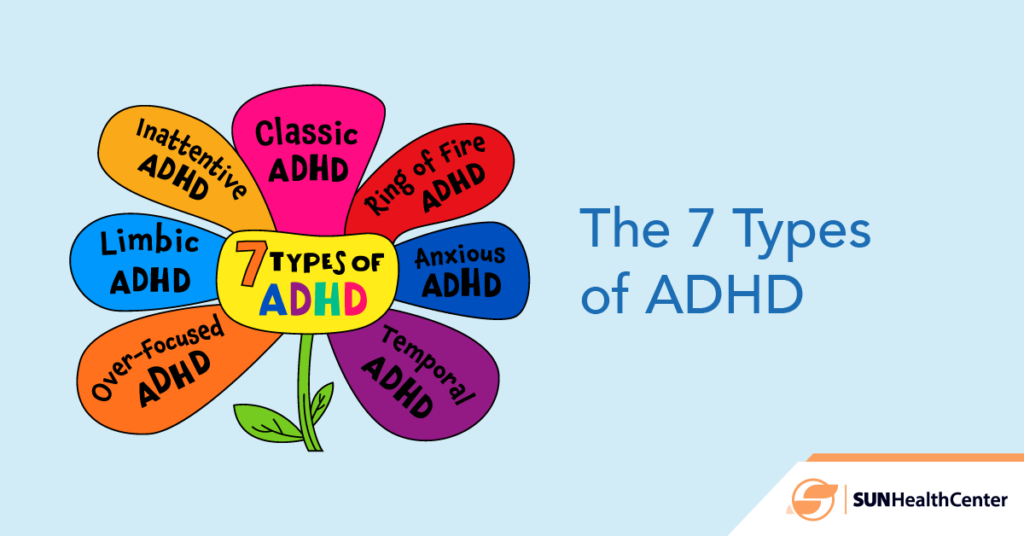
The medical community officially recognizes three presentations of ADHD in the DSM-5: predominantly inattentive, predominantly hyperactive-impulsive and combined type. However, psychiatrist Dr. Daniel Amen has proposed a more detailed framework identifying seven distinct types of ADHD based on his analysis of brain scans using single-photon emission computed tomography (SPECT). While these ADHD subtypes aren’t universally accepted in mainstream psychiatry due to limited peer-reviewed research, many people find this classification system helpful for understanding their unique symptoms and experiences. If you need help dealing with ADHD in your life or a loved one’s, Sun Health Center can help.
Let’s explore each of these seven types to help you better understand how ADHD might be affecting your life.
Type 1: Classic ADHD (Hyperactive/Impulsive)
This is what most people picture when they think of ADHD. Classic ADHD includes hyperactivity, impulsivity and inattention. If you have this type, you might feel like you’re constantly on the go, struggle to sit still and often act before thinking through the consequences.
You may find yourself interrupting others, starting projects with enthusiasm but struggling to finish them and having difficulty maintaining focus during meetings or conversations. This type typically shows up early in life. As babies, these individuals may be colicky and wiggly, while as children they’re often restless, noisy and demanding.
Type 2: Inattentive ADHD
Unlike classic ADHD, inattentive ADHD doesn’t come with hyperactivity. Instead, you might appear daydreamy, sluggish or easily distracted. You lose things frequently, struggle to complete tasks and have trouble following through on projects or commitments.
People with this type often fly under the radar because they’re not disruptive. You might be called “spacey” or accused of not listening, even when you’re trying your hardest to pay attention. This type is particularly common in girls and women, who are often underdiagnosed as a result.
Type 3: Overfocused ADHD
Overfocused ADHD combines the core symptoms of ADHD with obsessive or compulsive tendencies. If you have this type, you might get stuck on negative thoughts or behaviors and have extreme difficulty shifting your attention from one task to another.
You may be inflexible, argumentative and prone to holding grudges. You might also experience excessive worrying and have trouble letting go of perceived slights. This type can sometimes be mistaken for obsessive-compulsive disorder (OCD) due to the rigid thinking patterns involved.
Type 4: Temporal Lobe ADHD
This type involves abnormal activity in the temporal lobe, which manages memory processing, emotional regulation and sensory input. Along with typical ADHD symptoms, you might experience learning difficulties, memory problems, mood instability and occasional aggressive outbursts.
You may have trouble recalling details, processing information effectively and managing your emotions. Some people with temporal lobe ADHD also report experiencing unusual sensory perceptions or struggle with reading comprehension.
Type 5: Limbic ADHD
Limbic ADHD involves chronic low mood and energy alongside attention difficulties. The limbic system, which is your brain’s emotional control center, is overactive in this type. You might struggle with feelings of guilt, moodiness, low self-esteem and social withdrawal.
Unlike typical depression that might respond to standard antidepressants, limbic ADHD often requires a different treatment approach. You may feel persistently sad or hopeless and have little motivation, even for activities you once enjoyed.
Type 6: Ring of Fire ADHD
Ring of fire ADHD gets its name from brain scans showing a ring of overactivity throughout the entire brain. This type features extreme irritability, unpredictable behavior, mood swings and sensitivity to environmental stimuli such as noise or light.
If you have this type, you might experience intense emotional reactions to everyday situations and find it difficult to regulate your responses. You may also be oppositional and inflexible and experience cycles of both high and low energy. Traditional stimulant medications often make symptoms worse in this type.
Type 7: Anxious ADHD
Anxious ADHD combines attention difficulties with high levels of anxiety and stress. You might constantly anticipate worst-case scenarios, fear making mistakes and get caught in cycles of self-doubt and worry.
This type involves low activity in the prefrontal cortex as well as overactivity in the basal ganglia. You may experience physical symptoms of anxiety like tension, nervousness and racing thoughts while simultaneously struggling with focus and task completion. Social situations may be particularly challenging as you worry about being judged or making mistakes.
How Understanding Your Type of ADHD Can Help With Treatment
Recognizing which type of ADHD you might have is valuable because treatment approaches that work brilliantly for one type can be ineffective or even counterproductive for another. For instance, stimulant medications that help classic ADHD may worsen symptoms in ring of fire ADHD.
Understanding your specific presentation can guide you toward more targeted interventions. These might include specific medications, therapy approaches like cognitive behavioral therapy (CBT), lifestyle modifications including diet and exercise, stress management techniques and organizational strategies tailored to your challenges.
It’s important to note that while Dr. Amen’s seven-type framework isn’t the official diagnostic standard, it can serve as a useful tool for communicating your experiences to health care providers and understanding why your symptoms might differ from others with ADHD. The key is working with qualified professionals who can assess your individual situation and develop a personalized treatment plan.
Get Personalized ADHD Support at Sun Health Center
At Sun Health Center, we understand that every person’s experience with ADHD is unique. Our team takes a comprehensive approach to evaluating and treating ADHD, considering your specific symptoms, challenges and goals. Whether you’re seeking an initial diagnosis or looking for more effective management strategies, we’re here to help you thrive. Contact us today to schedule your consultation.